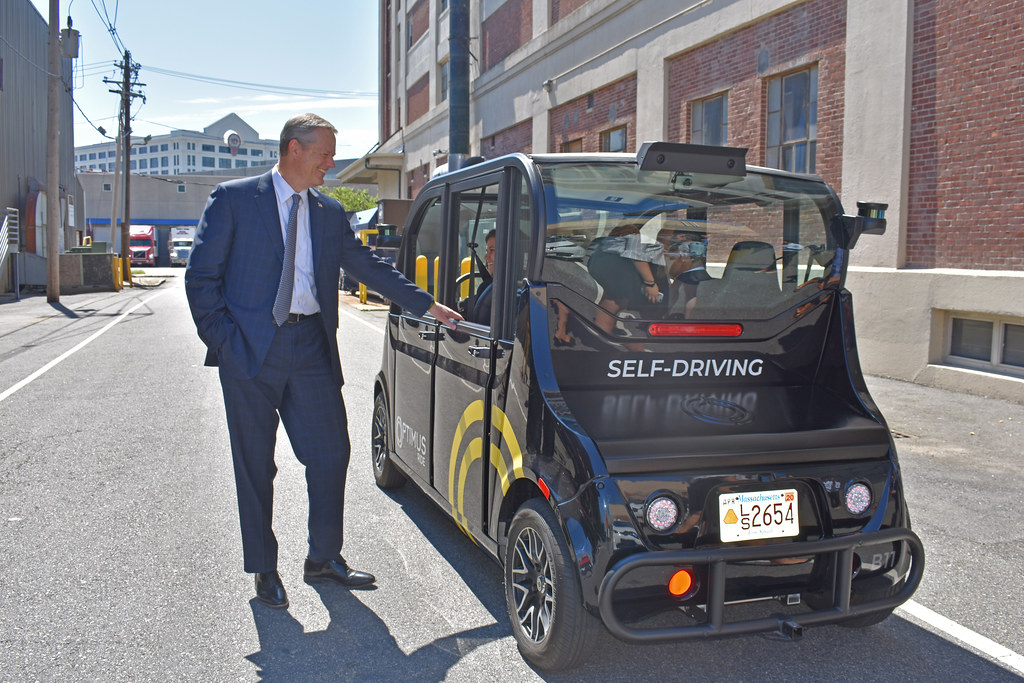
The Failing Promises of Autonomous Driving
How do blind people drive themselves to the store? Well, there is no way for them to do this, however with the idea of self-driving cars slowly becoming reality, they now have hope for the future. According to the author Ashley Nunes, who wrote “Self-Driving Cars: Should Automated Cars Be the Future of Transportation” in 2019 in USA Today, self -driving cars are not sustainable in our economy and is not a realistic outlook for the future. With Nunes credibility already built, he uses facts and statistics, and emotional points that will make the reader think about the future of automated cars, however his lack of playing with the readers’ emotions leads to a less impactful article.
The history of self-driving cars first originated in the 1920s when the Houdina Radio Control Company showed that a car could drive through traffic if it was given certain instructions. In 1939 researcher Norman Bel Geddes envisioned a fully automated highway system that would change the way road systems work. Some experiments were made but an automated road system made little to no progress for 20 years. In the 1960s researchers realized that cars would have to become smarter and then the road system would have to be. The engineers at Stanford in 1960 were the first to make a self-navigating machine that didn’t need a human to direct it. And now in the 21st century, many advancements have been made to make cars self-driving. With massive businesses such as Uber, Lyft, Tesla, Google, and more all trying to make the first self-driving car, the future of autonomous driving is now looking better than ever before. The development of self-driving cars has been a long road, and the idea has largely been seen as unrealistic, but with the advancement of technology, the future of self-driving cars is looking better than ever.
From the beginning of the article, we can tell that it’s going to be a very credible source and appeal to ethos to support his argument. Using ethos boosts Nunes’s article by supporting his main points and reaffirming that these aren’t facts that have been created. As soon as the article is viewed the reader can instantly notice that this source is credible. This is because it has been published by USA Today. USA Today has been around since 1982 and since then has been known to be a very credible source of information, they check the information that is published to ensure that everything is correct. In addition to this, the author Ashley Nunes is a researcher at the Massachusetts Institute of Technology and is also a research associate at Harvard Law School. Nunes has been published on multiple credible sources and is well known in the technology industry. All in all the article can be described as very credible having strong ethos, but Nunes doesn’t just have a strong appeal to credibility he also has strong facts to prove his point.
In addition to appealing to ethos, Nunes also appeals to logos which gives the readers facts about the topic. Nunes takes the information that the general population knows and uses it to support his point. In his USA Today article, “Self-Driving Cars: Should Automated Cars Be the Future of Transportation” author Ashley Nunes says “Their biggest expenses? Driver salaries. In the first quarter of 2018, Uber ranked in $11.3 billion in revenue, more than $8 billion of which was spent on paying drivers”(Nunes 1). Nunes uses this to start to talk about the expenses of having people work for a company instead of computers doing the work for them, making it seem like he is on board with self-driving cars. However, he then follows up with “For one thing driverless does not mean humanless. Machines are after all imperfect. They stumble just like humans do …the results can be deadly.”(Nunes 1)Companies such as Uber and Lyft are pouring money into self-driving cars to save money on paying people to drive cars. However, Nunes is stating that a human will always need to be in the vehicle to ensure that the passenger arrives safely to their destination. This takes away Uber and Lyfts dream of saving money. The contrasting statements and the reasoning for these contrasts build a strong appeal to logos and tells the reader that autonomous driving may never happen.
Not only does the article have strong appeals to ethos and logos, but it also uses pathos throughout the article. Using strong forms of pathos will make the reader connect to the article more than without it, so Nunes attempts to use it as much as possible. Nunes’s article has pathos scattered around in the article in a way that is subtle but noticeable to someone who is moved by it. For example “But when algorithms charged with our safety and security follow suit, the results can be deadly”(Nunes 1). Dying due to the failure of a computer running poorly would be a horrible thing to happen to someone. He also says, “Why buy a slice of (robo) transportation for $6 when you can pay significantly less in a regular car?”(Nunes 2). Money is one of the biggest factors in someone’s life, and saving it is a priority. So, stating that self-driving cars could not only be deadly but also more pricey than buying a car and driving yourself, opens the readers’ eyes to the reality of self-driving cars, and the lies that some companies have been saying. To conclude, connecting with the audience emotionally helps the author explains his point further and makes it seem more believable.
Nunes informs the reader throughout the article that autonomous cars are not going to be sustainable, he does this by having strong credibility and facts, however, doesn’t seem to draw the reader in with emotion. A lot of people believe that autonomous cars are going to be the next big innovation and will change the world, this may be true but, the expectations people have for this are too high and cannot be met. However, the world will progress, technology will advance, people’s expectations will change, and when all of these occurrences happen then the future of autonomous driving may be brighter. Humanless cars may not occur anytime soon, however, blind people can still rely on Uber and Lyft to transport and help them.

